NASA AND FLEXIBLE PACKAGING PT 1

Introduction
I recently had the pleasure of touring the American Space Museum in Titusville, FL. If you have never been, I would highly recommend a visit as most of the exhibits are either furloughed equipment or donations from ex-employees of NASA or contractors. In fact, the tour guide that we had worked on the Space Shuttle Program from 32 years! As a space geek, I was in heaven!
What got me thinking about this blog was the exhibit on the evolution of food packaging throughout the different space systems. From Projects Mercury, Gemini and Apollo to Space Shuttle, ISS and now Artemis/SLS, the story of packaging at NASA is the basis for what we Packaging Engineers take for granted every day. This is Part 1 of a series on uses of flexible packaging on flight at NASA. In this first part we will cover food packaging as it develops from Gemini in 1961 through the end of Apollo in 1975. Part 2 will take us through to the Artemis II mission in 2026.
Mercury & Gemini
Starting with the Mercury missions in 1961, NASA had to figure out how to feed an astronaut in space. While astronauts could not totally remove their suits during flight, they could open their visors if the atmosphere in the capsule was oxygen rich. They could also remove gloves for some of the time. Early on in American space exploration, the scientists on the ground were worried that chewing and swallowing would be impossible or cause the astronaut difficulty. To that end food consisted mainly of two things – Aluminum tubes filled with beef & gravy or tubes with fruit puree – like applesauce or peaches. These tubes were adapted from tubes that held artist paint, toothpaste, or other ointments. They had to be adapted for use by NASA with the addition of a food safe coating on the inside to keep acidic foods from reacting with the aluminum. They were also adapted with a long tube to more easily allow the astronaut to eat through his helmet opening. The other items to eat were dry food cubes that could dissolve in the mouth. These were deemed a problem due to the floating crumbs getting in behind consoles and control buttons. This was solved on later missions with the addition of gelatin, but the food was still disliked by astronauts.

Project Gemini brought the introduction of flexible packaging containing food out of necessity. As America entered the era of the Gemini missions to the moon, astronauts were suddenly spending 2-10 days on orbit. The first pouches used on Gemini missions featured a 4-ply structure consisting of a 4-layer structure starting with Polyester/Aclar/Nylon/LDPE. The pouches were supplied by the Whirlpool Corporation. They were in charge of the "Space Kitchen" which was designated to supply all of the food and packaging. Pillsbury was also brought in to help Whirlpool with food safety programs. Along with this high barrier structure, the pouch featured a new fitment with a spring-loaded one-way valve closure. When the valve was closed the spring kept the pouch under vacuum. When the spring was pushed in and water was allowed into the pouch, the vacuum was released and the food and water could be mixed from the outside of the pouch. To eat the food, the astronauts would remove a clip or cut the pouch with scissors on the other end of the pouch, releasing a tube and the food would be squeezed into the mouth. Think of pureed baby food squeezed through a tube. This was a marked improvement, but the astronauts still wanted better.

Apollo & Skylab
In 1967, America suffered a huge loss with the loss of Apollo 1. The three astronauts were caught in a capsule fire during a test and could not escape the inferno. For 20 months, NASA worked to get the Apollo program back up and running. The early Apollo missions were unmanned missions around the earth to test the Saturn V rocket and other systems. Starting with Apollo 7 in October 1968, manned missions began, starting with an 11-day mission in earth orbit testing the new command module. It was the last mission that used the Gemini era squeeze tube pouch.
Starting with Apollo 8 in December 1968, the astronauts were introduced to the Spoon-Bowl Pack. It consisted of the same 4-layer structure and the spring-loaded fitment used on Gemini pouches, but it included a huge improvement – the flexible plastic zipper. That zipper was developed by Steve Ausnit and manufactured by his company, Flexigrip, Inc. You know it better as Ziploc. While not the first commercial use for reclosing zippers, it marked an important collaboration between NASA and the flexible packaging industry that continues to today. To use the pouch, the astronauts would inject water with a water gun into the pouch and mix the water and food together. For Apollo 8, NASA introduced a hot water system for the water injection gun. They then would open the zipper, form a “bowl” with the pouch in the palm of the hand, and eat with a spoon. This marked the first time that astronauts could feel like they were eating normally in space as they would on earth. The Spoon-Bowl pouch system was used on every subsequent Apollo mission through 1972.

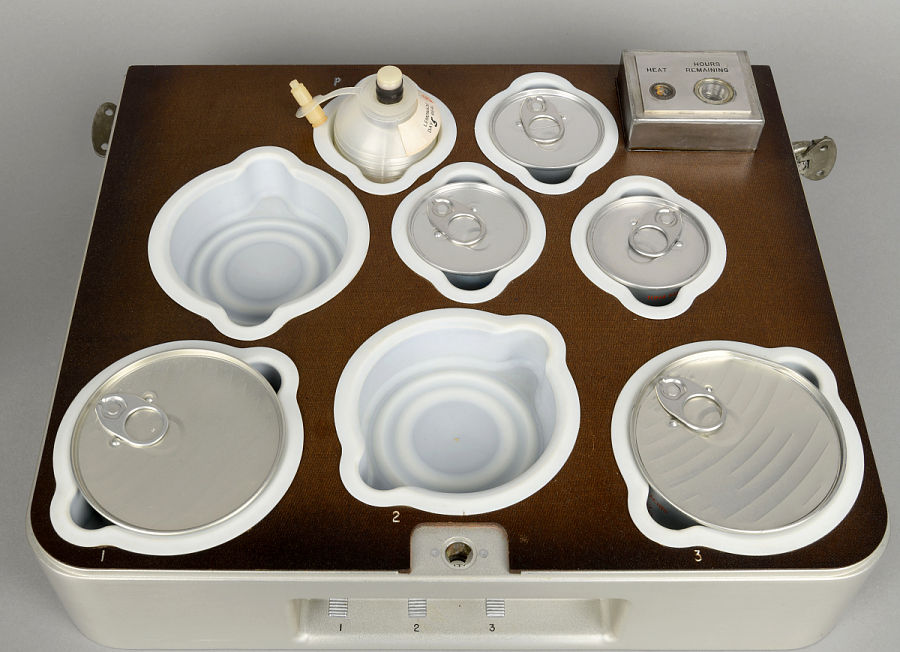
In 1973 The Skylab missions shelved the spoon-bowl design. Skylab was huge compared to the apollo capsules and had a refrigerator, freezer, and oven. The crew used rigid aluminum cans with pull-top lids. Originally introduced in 1965 to the supermarket, the design was adapted by NASA. Astronauts had the ability to open the cans, heat them up, and use normal utensils held down by magnets on a proper dining table. It was quite a welcome change for the crews.
For the Apollo/Soyuz mission in 1975, the Spoon-Bowl was returned to service. It would be the last time it was ever used. For the upcoming Space Shuttle, things were changing drastically.

